Advanced oils, lubricants
and treatments since 1887
Main Switchboard: +44 (0)1484 713201
Technical Support: +44 (0)1484 475060
Advanced oils, lubricants
and treatments since 1887
Main Switchboard: +44 (0)1484 713201
Technical Support: +44 (0)1484 475060
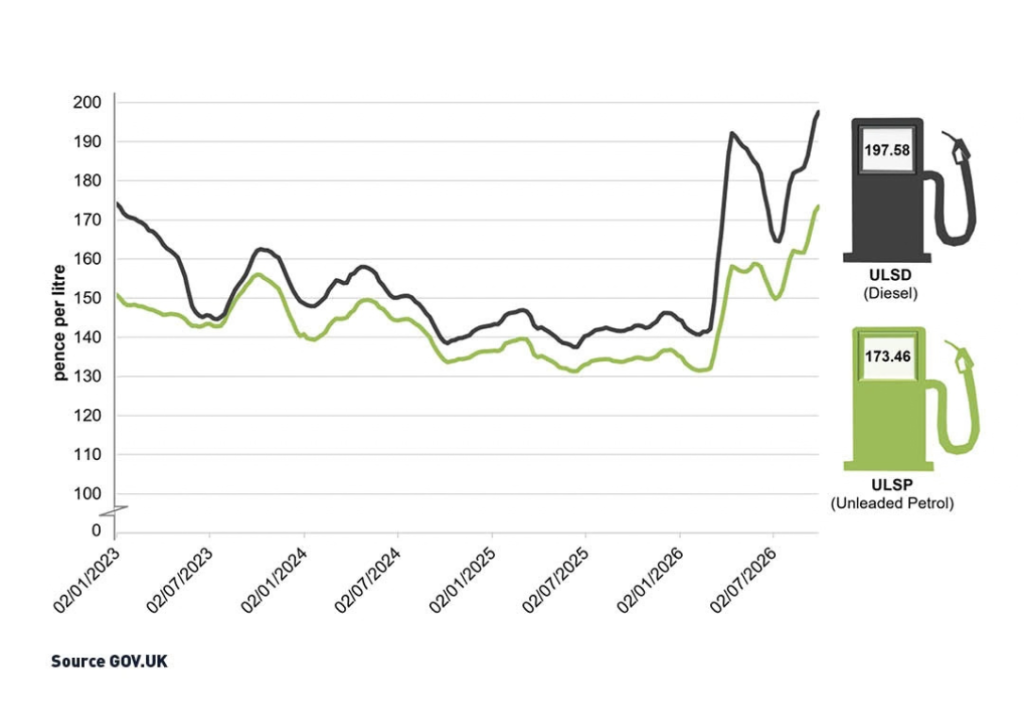
Fuel prices have a habit of becoming the focus of attention whenever they rise. Drivers notice the difference at the pump, while businesses see it reflected in their operating costs. But the true impact of rising fuel prices goes beyond the amount shown at the fuel station
For an everyday driver, higher fuel prices can mean a larger weekly or monthly household expense. For a business operating vehicles, the effect is multiplied across hundreds or thousands of journeys. And because road transport plays such an important role in moving people and goods around the UK, changes in fuel costs can have wider consequences too.
The latest figures show just how quickly the cost of filling up can change. According to GOV.UK average UK petrol and diesel prices increased by 11.85p and 14.09p per litre respectively in September alone. On 30th September, the RAC Foundation reported that the UK average price of diesel had passed £2 per litre. Petrol was reported at 174.7p per litre.
Pump prices are made up of several elements, including the underlying fuel cost, refining and distribution, retailer and wholesaler costs, fuel duty and VAT. Fuel taxation makes up a substantial proportion of the price. The RAC Foundation’s analysis of the £2-per-litre diesel price found that 86p (around 43%) went to the Treasury through fuel duty and VAT. Fuel duty was 52.95p per litre, with VAT then applied to the fuel price including duty.
The underlying cost of fuel can also move considerably. Global oil markets, supply and demand, refining capacity and exchange rates can all influence the price paid in the UK. Because oil is traded internationally in US dollars, the value of sterling can also affect UK fuel costs.
A delivery company needs fuel to make deliveries. A tradesperson needs fuel to travel between jobs. A waste operator needs fuel to collect waste. A logistics company needs fuel to move goods between warehouses, businesses and customers. This means that when fuel becomes more expensive, businesses face higher operating costs, and the wider economy can feel the impact too.
The Office for National Statistics reported that transport, particularly motor fuels, made the largest upward contribution to the change in annual CPI inflation between July and August 2026. Motor fuel prices had risen by 23% over the 12 months to August. Not every business will pass higher fuel costs directly on to customers, and the effect varies between industries. But the cost of moving people and goods is an important part of the wider picture.
Where fuel efficiency becomes particularly important for businesses, and small differences become big numbers.
Consider a fleet of 10 diesel vans, each travelling 25,000 miles a year. If each vehicle averages 35 miles per gallon, the fleet would use roughly 32,500 litres of fuel per year.
At £1.50 per litre (the price in March 2026), that’s approximately: £48,705 per year
At £2 per litre (the price now): £64,940 per year
That’s a difference of £16,235, before considering any changes in mileage or fuel consumption.
When fuel prices rise, even small differences in fuel consumption can become significant across a fleet. That’s why businesses need to look beyond the price per litre and consider how efficiently they’re using the fuel they’re buying.
Nobody driving a petrol or diesel vehicle can control global oil markets, but there are plenty of things that can influence how much fuel a vehicle uses.
1. How you drive
Unnecessary acceleration, harsh braking and excessive idling all use energy that doesn’t necessarily contribute to getting you where you’re going. Research published by the RAC in June 2026 estimated that fleets could potentially reduce fuel costs by up to 15% through better use of driver data, identifying behaviours including excessive idling, harsh acceleration and braking, and inefficient route planning.
2. How you plan the journey
Planning efficient routes, avoiding unnecessary mileage and reducing time spent sitting in traffic can all help make better use of the fuel available. For fleet operators, telematics can provide useful insight into driving patterns, route efficiency and vehicle performance, helping businesses identify where changes could improve overall efficiency.
3. How well you look after the vehicle
Maintaining vehicles in line with manufacturers’ standards can support fuel efficiency and reduce harmful exhaust emissions. Routine servicing and preventative maintenance shouldn’t simply be viewed as ways of avoiding breakdowns, they can also form part of a wider approach to keeping vehicles operating efficiently.
Tyres are a good example. The Government’s ‘Guide to Maintaining Roadworthiness’ states that correctly inflated tyres can help reduce fuel consumption, while a 20% drop in tyre pressure can result in a 2% increase in fuel consumption. Regularly checking tyre pressures is therefore a relatively simple step that can help support efficient operation.
The fuel system is working every time the engine is running. Over time, deposits and contamination can affect fuel-system cleanliness and performance of fuel-system components.
Fuel treatments can be used as part of this approach. Designed to help clean and maintain the fuel system, they can help manage deposits and support the ongoing cleanliness and performance of key fuel-system components. For drivers and fleet operators, incorporating a suitable fuel treatment into a regular maintenance routine can be a simple additional step towards supporting efficient operation and getting the most from every litre.
Rising fuel prices are a challenge for almost anyone who relies on a vehicle, and the price is influenced by factors far beyond the control of an individual driver or business. But fuel consumption is not entirely outside your control. Monitoring fuel use, managing driver behaviour and maintaining vehicles properly can all form part of a wider strategy for controlling operating costs. And when those small improvements are multiplied across thousands of miles and multiple vehicles, they can become much more meaningful.
More about Millers Oils


